• Steven Ponce
  • About
  • Data Visualizations
  • Projects
  • Resume
  • Email

On this page

  • Challenge
  • Visualization
  • Steps to Create this Graphic
    • 1. Load Packages & Setup
    • 2. Read in the Data
    • 3. Examine the Data
    • 4. Tidy Data
    • 5. Visualization Parameters
    • 6. Plot
    • 7. Save
    • 8. Session Info
    • 9. GitHub Repository
    • 10. References
    • 11. Custom Functions Documentation

Maternity Care Deserts Span Large Regions of the United States

  • Show All Code
  • Hide All Code

  • View Source

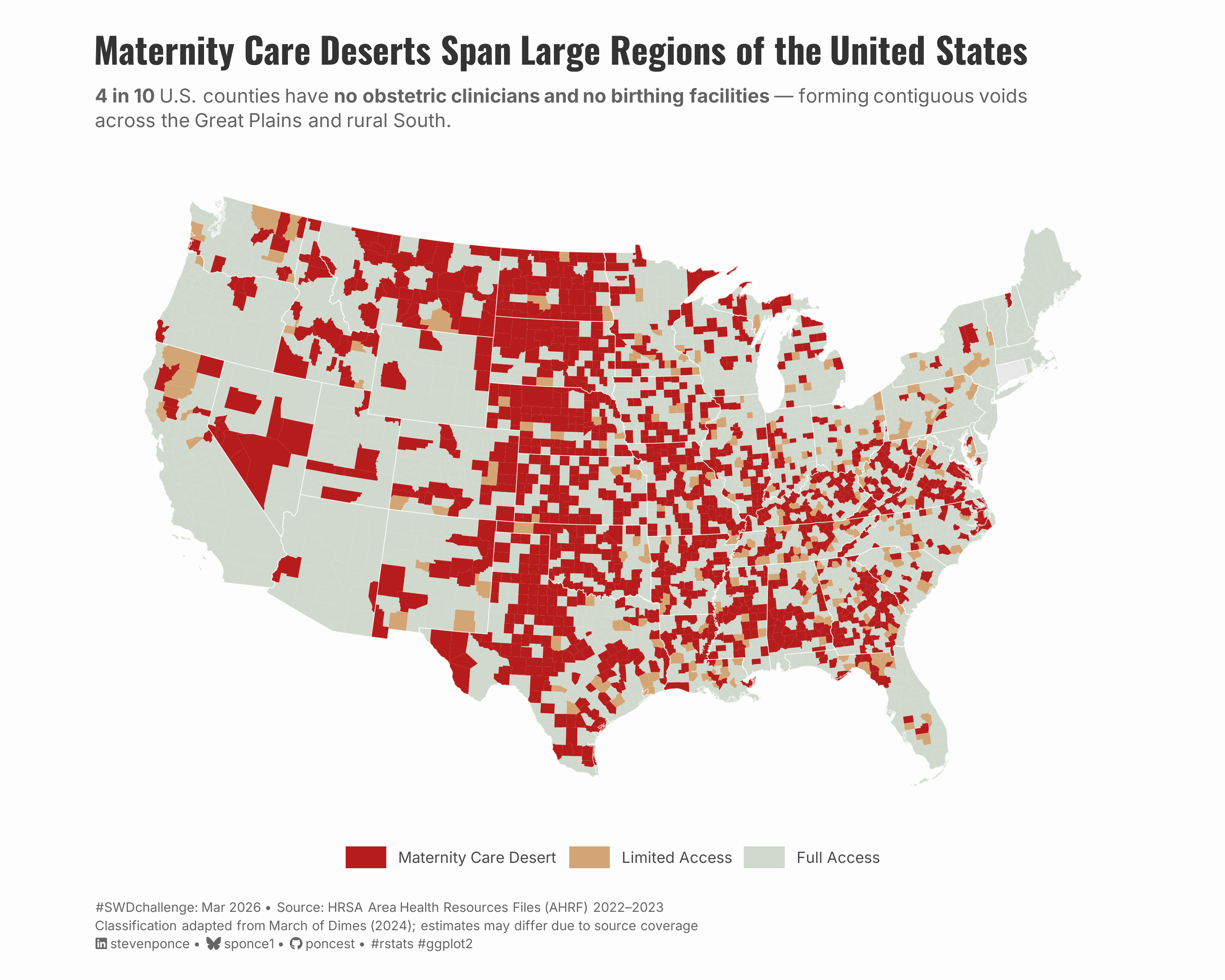
4 in 10 U.S. counties have no obstetric clinicians and no birthing facilities — forming contiguous voids across the Great Plains and rural South.

SWDchallenge
Data Visualization
R Programming
2026
A county-level choropleth map revealing that 4 in 10 U.S. counties have zero maternity care — no obstetric clinicians and no birthing facilities. Using HRSA Area Health Resources Files (AHRF) 2022–2023 and classification logic adapted from the March of Dimes (2024), the map demonstrates how maternity care deserts form contiguous regional voids across the Great Plains and rural South, not isolated gaps — an insight only geography can reveal.
Author

Steven Ponce

Published

March 1, 2026

Challenge

This month’s challenge asks you to create a visualization that uses a map intentionally, revealing an insight that would be difficult or impossible to see without a spatial view.

Additional information can be found HERE

Visualization

Figure 1: A choropleth map of the contiguous United States showing maternity care access by county. Counties are classified into three categories: Maternity Care Desert (deep red), Limited Access (muted tan), and Full Access (near-white). The map reveals large contiguous regions of zero maternity care — defined as no obstetric clinicians and no birthing facilities — concentrated across the Great Plains, rural South, and parts of the Mountain West. 4 in 10 U.S. counties fall into this category, forming unbroken voids spanning hundreds of miles rather than isolated gaps. Full Access counties cluster along the coasts, in the Upper Midwest, and in metropolitan areas. Data source: HRSA Area Health Resources Files (AHRF) 2022–2023; classification adapted from March of Dimes (2024).

Steps to Create this Graphic

1. Load Packages & Setup

Show code
```{r}
#| label: load

if (!require("pacman")) install.packages("pacman")
pacman::p_load(
tidyverse, ggtext, showtext, janitor,
  scales, glue, vroom, sf, tigris
)

### |- figure size ---- 
camcorder::gg_record(
  dir    = here::here("temp_plots"),
  device = "png",
  width  = 10,
  height = 8,
  units  = "in",
  dpi    = 320
)

# Source utility functions
suppressMessages(source(here::here("R/utils/fonts.R")))
source(here::here("R/utils/social_icons.R"))
source(here::here("R/utils/image_utils.R"))
source(here::here("R/themes/base_theme.R"))
```

2. Read in the Data

Show code
```{r}
#| label: read

data_dir <- here::here("data/SWDchallenge/2026/")

ahrf_geo <- vroom(
  file.path(data_dir, "ahrf2023GEO.csv"),
  col_select     = c(fips_st_cnty, cnty_name_st_abbrev),
  show_col_types = FALSE
) |> clean_names()

ahrf_hp <- vroom(
  file.path(data_dir, "ahrf2023HP.csv"),
  col_select = c(
    fips_st_cnty, md_nf_obgyn_gen_21, do_nf_obgyn_gen_21,
    apn_midwvs_npi_22
  ),
  show_col_types = FALSE
) |> clean_names()
# NOTE: apn_midwvs_npi_22 = Advanced Practice Nurses / Midwives (NPI registry, 2022)
# More specific than clin_nurse_spec_npi_22 (all clinical nurse specialists).

ahrf_hf <- vroom(
  file.path(data_dir, "ahrf2023HF.csv"),
  col_select = c(
    fips_st_cnty, stgh_obstetrc_care_21,
    stgh_birth_postprtm_rm_21
  ),
  show_col_types = FALSE
) |> clean_names()

ahrf_pop <- vroom(
  file.path(data_dir, "ahrf2023POP.csv"),
  col_select     = c(fips_st_cnty, births_july_1_june_30_22),
  show_col_types = FALSE
) |> clean_names()
```

3. Examine the Data

Show code
```{r}
#| label: examine
#| include: true
#| eval: true
#| results: 'hide'
#| warning: false

# data list
ahrf_list <- list(
  geo = ahrf_geo,
  hp  = ahrf_hp,
  hf  = ahrf_hf,
  pop = ahrf_pop
)

# walk + glimpse
ahrf_list |> walk(glimpse)
```

4. Tidy Data

Show code
```{r}
#| label: tidy
#| output: false

### |- safe cleaner: replace NA and negative codes with 0 ----
# AHRF sometimes encodes missing as -1, -9, etc.
clean0 <- function(x) replace_na(x, 0) |> pmax(0)

### |- FIPS key ----
ahrf_keys <- ahrf_geo |>
  select(fips = fips_st_cnty, county_name = cnty_name_st_abbrev) |>
  mutate(fips = str_pad(as.character(fips), 5, pad = "0")) |>
  filter(!str_ends(fips, "000"))

### |- Clinicians ----
ahrf_clinicians <- ahrf_hp |>
  select(
    fips = fips_st_cnty,
    n_md_obgyn = md_nf_obgyn_gen_21,
    n_do_obgyn = do_nf_obgyn_gen_21,
    n_cnm = apn_midwvs_npi_22
  ) |>
  mutate(fips = str_pad(as.character(fips), 5, pad = "0")) |>
  filter(!str_ends(fips, "000"))

### |- Facilities ----
ahrf_facilities <- ahrf_hf |>
  select(
    fips = fips_st_cnty,
    n_ob_hospitals = stgh_obstetrc_care_21,
    n_birth_centers = stgh_birth_postprtm_rm_21
  ) |>
  mutate(fips = str_pad(as.character(fips), 5, pad = "0")) |>
  filter(!str_ends(fips, "000"))

### |- Births ----
ahrf_population <- ahrf_pop |>
  select(
    fips = fips_st_cnty,
    n_births = births_july_1_june_30_22
  ) |>
  mutate(fips = str_pad(as.character(fips), 5, pad = "0")) |>
  filter(!str_ends(fips, "000"))

### |- Join ----
ahrf_combined <- ahrf_keys |>
  left_join(ahrf_clinicians, by = "fips") |>
  left_join(ahrf_facilities, by = "fips") |>
  left_join(ahrf_population, by = "fips")

### |- Housekeeping ----
rm(
  ahrf_clinicians, ahrf_facilities, ahrf_geo, ahrf_hf,
  ahrf_hp, ahrf_keys, ahrf_pop, ahrf_population
)
gc()

### |- Classify ----
ahrf_classified <- ahrf_combined |>
  mutate(
    # Apply clean0 to all raw counts — handles NA and negative AHRF codes
    across(
      c(n_md_obgyn, n_do_obgyn, n_cnm, n_ob_hospitals, n_birth_centers, n_births),
      clean0
    ),
    n_ob_gyn = n_md_obgyn + n_do_obgyn,
    n_clinicians = n_ob_gyn + n_cnm, # OB-GYN (MD+DO) + APN midwives
    clinician_rate = if_else(n_births > 0, n_clinicians / n_births * 10000, 0),
    n_facilities = n_ob_hospitals + n_birth_centers,
    access_class = case_when(
      n_facilities == 0 & n_clinicians == 0 ~ "Maternity Care Desert",
      n_facilities >= 2 | clinician_rate >= 60 ~ "Full Access",
      TRUE ~ "Limited Access"
    ),
    access_class = factor(
      access_class,
      levels = c("Maternity Care Desert", "Limited Access", "Full Access")
    )
  )

### |- Validation ----
cat("\n--- Classification Distribution ---\n")
ahrf_classified |>
  count(access_class) |>
  mutate(pct = round(n / sum(n) * 100, 1)) |>
  print()
# Note: ~40% observed vs MoD 35.1% — gap reflects AHRF data scope
# (AHRF lacks ABFM family physician and AABC birth center registries used by MoD)
```

5. Visualization Parameters

Show code
```{r}
#| label: params

### |-  plot aesthetics ----
colors <- get_theme_colors(
  palette = list(
    desert  = "#B71C1C",  
    limited = "#D4A574",  
    full    = "#D1D9CE",
    county  = NA,          
    state   = "#FFFFFF"
  )
)

### |- titles and caption ----
title_text <- "Maternity Care Deserts Span Large Regions of the United States"

subtitle_text <- paste0(
  "**4 in 10** U.S. counties have **no obstetric clinicians and no birthing facilities** — ",
  "forming contiguous voids<br>across the Great Plains and rural South."
)

caption_text <- create_swd_caption(
  year        = 2026,
  month       = "Mar",
  source_text = paste0(
    "HRSA Area Health Resources Files (AHRF) 2022–2023<br>",
    "Classification adapted from March of Dimes (2024); estimates may differ due to source coverage"
  )
)

### |- fonts ----
setup_fonts()
fonts <- get_font_families()

### |- plot theme ----
base_theme <- create_base_theme(colors)

weekly_theme <- extend_weekly_theme(
  base_theme,
  theme(
    plot.background  = element_rect(fill = colors$palette$bg, color = NA),
    panel.background = element_rect(fill = colors$palette$bg, color = NA),
    plot.title = element_text(
      size = 18, face = "bold", color = "#1A1A1A",
      margin = margin(b = 4)
    ),
    plot.subtitle = element_markdown(
      size = 11, color = "#4A4A4A", lineheight = 1.5,
      margin = margin(b = 4)
    ),
    plot.caption = element_markdown(
      size = 7.5, color = "#888888", hjust = 0,
      margin = margin(t = 10)
    ),
    legend.text = element_text(size = 9, color = "#4A4A4A"),
    legend.background = element_rect(fill = NA, color = NA),
    legend.title = element_blank()
  )
)

theme_set(weekly_theme)
```

6. Plot

Show code
```{r}
#| label: plot
#| output: false

### |- county geometry ----
counties_sf <- counties(cb = TRUE, year = 2022, resolution = "20m") |>
  clean_names() |>
  select(fips = geoid, geometry) |>
  filter(!str_sub(fips, 1, 2) %in% c("02", "15", "60", "66", "69", "72", "78"))

### |- state geometry ----
states_sf <- states(cb = TRUE, year = 2022) |>
  clean_names() |>
  filter(!stusps %in% c("AK", "HI", "PR", "GU", "VI", "MP", "AS"))

### |- join ----
map_df <- counties_sf |>
  left_join(ahrf_classified |> select(fips, access_class), by = "fips")

cat("Unmatched counties:", sum(is.na(map_df$access_class)), "\n")

### |- transform geometry once (faster at high DPI) ----
map_df_t <- st_transform(map_df, 5070)
states_sf_t <- st_transform(states_sf, 5070)

### |- legend labels ----
legend_labels <- c(
  "Maternity Care Desert" = "Maternity Care Desert",
  "Limited Access"        = "Limited Access",
  "Full Access"           = "Full Access"
)

### |- build map ----
p <- ggplot() +
  # Geoms
  geom_sf(
    data      = map_df_t,
    aes(fill  = access_class),
    color     = NA,
    linewidth = 0
  ) +
  geom_sf(
    data      = states_sf_t,
    fill      = NA,
    color     = alpha("#FFFFFF", 0.65),
    linewidth = 0.2
  ) +
  # Scales
  scale_fill_manual(
    values = c(
      "Maternity Care Desert" = colors$palette$desert,
      "Limited Access"  = colors$palette$limited,
      "Full Access" = colors$palette$full
    ),
    breaks   = c("Maternity Care Desert", "Limited Access", "Full Access"),
    labels   = legend_labels,
    na.value = "#E8E8E8",
    drop     = FALSE
  ) +
  coord_sf(datum = NA) +
  # Labs
  labs(
    title    = title_text,
    subtitle = subtitle_text,
    caption  = caption_text,
    fill     = NULL
  ) +
  # Theme
  theme(
    plot.title = element_markdown(
      size = rel(1.5),
      family = fonts$title,
      face = "bold",
      color = colors$title,
      lineheight = 1.15,
      margin = margin(t = 5, b = 5)
    ),
    plot.subtitle = element_markdown(
      size = rel(0.8),
      family = fonts$subtitle,
      color = alpha(colors$subtitle, 0.88),
      lineheight = 1.3,
      margin = margin(t = 5, b = 20)
    ),
    plot.caption = element_markdown(
      size = rel(0.55),
      family = fonts$subtitle,
      color = colors$caption,
      hjust = 0,
      lineheight = 1.4,
      margin = margin(t = 20, b = 5)
    ),
    legend.position   = "bottom",
    legend.direction  = "horizontal",
    legend.key.width  = unit(24, "pt"),
    legend.key.height = unit(13, "pt"),
    legend.spacing.x  = unit(8, "pt"),
    legend.margin     = margin(t = 4),
    plot.margin       = margin(t = 16, r = 20, b = 12, l = 20)
  )
```

7. Save

Show code
```{r}
#| label: save

### |-  plot image ----  
save_plot(
  p, 
  type = 'swd', 
  year = 2026, 
  month = 03, 
  width  = 10,
  height = 8,
  )
```

8. Session Info

Expand for Session Info
R version 4.4.1 (2024-06-14 ucrt)
Platform: x86_64-w64-mingw32/x64
Running under: Windows 11 x64 (build 26100)

Matrix products: default


locale:
[1] LC_COLLATE=English_United States.utf8 
[2] LC_CTYPE=English_United States.utf8   
[3] LC_MONETARY=English_United States.utf8
[4] LC_NUMERIC=C                          
[5] LC_TIME=English_United States.utf8    

time zone: America/New_York
tzcode source: internal

attached base packages:
[1] stats     graphics  grDevices utils     datasets  methods   base     

other attached packages:
 [1] here_1.0.2      tigris_2.2.1    sf_1.0-24       vroom_1.6.5    
 [5] glue_1.8.0      scales_1.4.0    janitor_2.2.1   showtext_0.9-7 
 [9] showtextdb_3.0  sysfonts_0.8.9  ggtext_0.1.2    lubridate_1.9.5
[13] forcats_1.0.1   stringr_1.6.0   dplyr_1.2.0     purrr_1.2.1    
[17] readr_2.1.6     tidyr_1.3.2     tibble_3.3.1    ggplot2_4.0.2  
[21] tidyverse_2.0.0 pacman_0.5.1   

loaded via a namespace (and not attached):
 [1] gtable_0.3.6       xfun_0.47          htmlwidgets_1.6.4  tzdb_0.5.0        
 [5] vctrs_0.7.1        tools_4.4.0        generics_0.1.3     curl_5.2.1        
 [9] parallel_4.4.0     gifski_1.32.0-2    proxy_0.4-29       pkgconfig_2.0.3   
[13] KernSmooth_2.23-22 RColorBrewer_1.1-3 S7_0.2.1           uuid_1.2-0        
[17] lifecycle_1.0.5    compiler_4.4.0     farver_2.1.2       textshaping_0.3.7 
[21] codetools_0.2-20   snakecase_0.11.1   htmltools_0.5.8.1  class_7.3-22      
[25] yaml_2.3.10        pillar_1.11.1      crayon_1.5.2       classInt_0.4-11   
[29] camcorder_0.1.0    magick_2.9.0       commonmark_2.0.0   tidyselect_1.2.1  
[33] digest_0.6.37      stringi_1.8.3      rsvg_2.6.0         rprojroot_2.1.1   
[37] fastmap_1.2.0      grid_4.4.0         cli_3.6.5          magrittr_2.0.4    
[41] utf8_1.2.4         e1071_1.7-17       withr_3.0.1        rappdirs_0.3.3    
[45] bit64_4.0.5        timechange_0.4.0   rmarkdown_2.28     httr_1.4.8        
[49] bit_4.0.5          ragg_1.5.0         hms_1.1.4          evaluate_1.0.0    
[53] knitr_1.48         markdown_1.12      rlang_1.1.7        gridtext_0.1.5    
[57] Rcpp_1.1.1         DBI_1.2.2          xml2_1.5.2         svglite_2.2.2     
[61] rstudioapi_0.18.0  jsonlite_2.0.0     R6_2.5.1           systemfonts_1.3.1 
[65] units_1.0-0       

9. GitHub Repository

Expand for GitHub Repo

The complete code for this analysis is available in swd_2026_03.qmd. For the full repository, click here.

10. References

Expand for References

SWD Challenge: - Storytelling with Data: Mar 2026 | mapping with purpose

Data Sources: - U.S. Health Resources & Services Administration. (2023). Area Health Resources Files (AHRF) 2022–2023. Retrieved March 1, 2026, from https://data.hrsa.gov/data/download - U.S. Census Bureau. (2022). TIGER/Line Shapefiles: Counties and States. Accessed via the tigris R package. https://www.census.gov/geographies/mapping-files/time-series/geo/tiger-line-file.html

Classification Reference: - March of Dimes. (2024). Nowhere to Go: Maternity Care Deserts Across the United States. https://www.marchofdimes.org/maternity-care-deserts-report

Book Reference: - Knaflic, C. N., Cisneros, A., & Velez, K. (2025). storytelling with data: before & after. Wiley. Chapter 4: Mapping with Purpose.

11. Custom Functions Documentation

📦 Custom Helper Functions

This analysis uses custom functions from my personal module library for efficiency and consistency across projects.

Functions Used:

  • fonts.R: setup_fonts(), get_font_families() - Font management with showtext
  • social_icons.R: create_social_caption() - Generates formatted social media captions
  • image_utils.R: save_plot() - Consistent plot saving with naming conventions
  • base_theme.R: create_base_theme(), extend_weekly_theme(), get_theme_colors() - Custom ggplot2 themes

Why custom functions?
These utilities standardize theming, fonts, and output across all my data visualizations. The core analysis (data tidying and visualization logic) uses only standard tidyverse packages.

Source Code:
View all custom functions → GitHub: R/utils

Back to top
Source Code
---
title: "Maternity Care Deserts Span Large Regions of the United States"
subtitle: "4 in 10 U.S. counties have no obstetric clinicians and no birthing facilities — forming contiguous voids across the Great Plains and rural South."
description: "A county-level choropleth map revealing that 4 in 10 U.S. counties have zero maternity care — no obstetric clinicians and no birthing facilities. Using HRSA Area Health Resources Files (AHRF) 2022–2023 and classification logic adapted from the March of Dimes (2024), the map demonstrates how maternity care deserts form contiguous regional voids across the Great Plains and rural South, not isolated gaps — an insight only geography can reveal."
author: "Steven Ponce"
date: "2026-03-01" 
categories: ["SWDchallenge", "Data Visualization", "R Programming", "2026"]
tags: [
  "choropleth-map",
  "maternity-care",
  "health-equity",
  "mapping-with-purpose",
  "figure-ground",
  "county-level",
  "public-health",
  "ggplot2",
  "sf",
  "tigris",
  "AHRF",
  "March-of-Dimes"
]
image: "thumbnails/swd_2026_03.png"
format:
  html:
    toc: true
    toc-depth: 5
    code-link: true
    code-fold: true
    code-tools: true
    code-summary: "Show code"
    self-contained: true
editor_options: 
  chunk_output_type: inline
execute: 
  freeze: true                                          
  cache: true                                                   
  error: false
  message: false
  warning: false
  eval: true
---

### Challenge

This month’s challenge asks you to create a visualization that uses a map intentionally, revealing an insight that would be difficult or impossible to see without a spatial view.

Additional information can be found [HERE](https://community.storytellingwithdata.com/challenges/mar-2026-mapping-with-purpose)

### Visualization
![A choropleth map of the contiguous United States showing maternity care access by county. Counties are classified into three categories: Maternity Care Desert (deep red), Limited Access (muted tan), and Full Access (near-white). The map reveals large contiguous regions of zero maternity care — defined as no obstetric clinicians and no birthing facilities — concentrated across the Great Plains, rural South, and parts of the Mountain West. 4 in 10 U.S. counties fall into this category, forming unbroken voids spanning hundreds of miles rather than isolated gaps. Full Access counties cluster along the coasts, in the Upper Midwest, and in metropolitan areas. Data source: HRSA Area Health Resources Files (AHRF) 2022–2023; classification adapted from March of Dimes (2024).](swd_2026_03.png){#fig-1}

### <mark> **Steps to Create this Graphic** </mark>

#### 1. Load Packages & Setup

```{r}
#| label: load

if (!require("pacman")) install.packages("pacman")
pacman::p_load(
tidyverse, ggtext, showtext, janitor,
  scales, glue, vroom, sf, tigris
)

### |- figure size ---- 
camcorder::gg_record(
  dir    = here::here("temp_plots"),
  device = "png",
  width  = 10,
  height = 8,
  units  = "in",
  dpi    = 320
)

# Source utility functions
suppressMessages(source(here::here("R/utils/fonts.R")))
source(here::here("R/utils/social_icons.R"))
source(here::here("R/utils/image_utils.R"))
source(here::here("R/themes/base_theme.R"))
```

#### 2. Read in the Data

```{r}
#| label: read

data_dir <- here::here("data/SWDchallenge/2026/")

ahrf_geo <- vroom(
  file.path(data_dir, "ahrf2023GEO.csv"),
  col_select     = c(fips_st_cnty, cnty_name_st_abbrev),
  show_col_types = FALSE
) |> clean_names()

ahrf_hp <- vroom(
  file.path(data_dir, "ahrf2023HP.csv"),
  col_select = c(
    fips_st_cnty, md_nf_obgyn_gen_21, do_nf_obgyn_gen_21,
    apn_midwvs_npi_22
  ),
  show_col_types = FALSE
) |> clean_names()
# NOTE: apn_midwvs_npi_22 = Advanced Practice Nurses / Midwives (NPI registry, 2022)
# More specific than clin_nurse_spec_npi_22 (all clinical nurse specialists).

ahrf_hf <- vroom(
  file.path(data_dir, "ahrf2023HF.csv"),
  col_select = c(
    fips_st_cnty, stgh_obstetrc_care_21,
    stgh_birth_postprtm_rm_21
  ),
  show_col_types = FALSE
) |> clean_names()

ahrf_pop <- vroom(
  file.path(data_dir, "ahrf2023POP.csv"),
  col_select     = c(fips_st_cnty, births_july_1_june_30_22),
  show_col_types = FALSE
) |> clean_names()
```

#### 3. Examine the Data

```{r}
#| label: examine
#| include: true
#| eval: true
#| results: 'hide'
#| warning: false

# data list
ahrf_list <- list(
  geo = ahrf_geo,
  hp  = ahrf_hp,
  hf  = ahrf_hf,
  pop = ahrf_pop
)

# walk + glimpse
ahrf_list |> walk(glimpse)
```

#### 4. Tidy Data

```{r}
#| label: tidy
#| output: false

### |- safe cleaner: replace NA and negative codes with 0 ----
# AHRF sometimes encodes missing as -1, -9, etc.
clean0 <- function(x) replace_na(x, 0) |> pmax(0)

### |- FIPS key ----
ahrf_keys <- ahrf_geo |>
  select(fips = fips_st_cnty, county_name = cnty_name_st_abbrev) |>
  mutate(fips = str_pad(as.character(fips), 5, pad = "0")) |>
  filter(!str_ends(fips, "000"))

### |- Clinicians ----
ahrf_clinicians <- ahrf_hp |>
  select(
    fips = fips_st_cnty,
    n_md_obgyn = md_nf_obgyn_gen_21,
    n_do_obgyn = do_nf_obgyn_gen_21,
    n_cnm = apn_midwvs_npi_22
  ) |>
  mutate(fips = str_pad(as.character(fips), 5, pad = "0")) |>
  filter(!str_ends(fips, "000"))

### |- Facilities ----
ahrf_facilities <- ahrf_hf |>
  select(
    fips = fips_st_cnty,
    n_ob_hospitals = stgh_obstetrc_care_21,
    n_birth_centers = stgh_birth_postprtm_rm_21
  ) |>
  mutate(fips = str_pad(as.character(fips), 5, pad = "0")) |>
  filter(!str_ends(fips, "000"))

### |- Births ----
ahrf_population <- ahrf_pop |>
  select(
    fips = fips_st_cnty,
    n_births = births_july_1_june_30_22
  ) |>
  mutate(fips = str_pad(as.character(fips), 5, pad = "0")) |>
  filter(!str_ends(fips, "000"))

### |- Join ----
ahrf_combined <- ahrf_keys |>
  left_join(ahrf_clinicians, by = "fips") |>
  left_join(ahrf_facilities, by = "fips") |>
  left_join(ahrf_population, by = "fips")

### |- Housekeeping ----
rm(
  ahrf_clinicians, ahrf_facilities, ahrf_geo, ahrf_hf,
  ahrf_hp, ahrf_keys, ahrf_pop, ahrf_population
)
gc()

### |- Classify ----
ahrf_classified <- ahrf_combined |>
  mutate(
    # Apply clean0 to all raw counts — handles NA and negative AHRF codes
    across(
      c(n_md_obgyn, n_do_obgyn, n_cnm, n_ob_hospitals, n_birth_centers, n_births),
      clean0
    ),
    n_ob_gyn = n_md_obgyn + n_do_obgyn,
    n_clinicians = n_ob_gyn + n_cnm, # OB-GYN (MD+DO) + APN midwives
    clinician_rate = if_else(n_births > 0, n_clinicians / n_births * 10000, 0),
    n_facilities = n_ob_hospitals + n_birth_centers,
    access_class = case_when(
      n_facilities == 0 & n_clinicians == 0 ~ "Maternity Care Desert",
      n_facilities >= 2 | clinician_rate >= 60 ~ "Full Access",
      TRUE ~ "Limited Access"
    ),
    access_class = factor(
      access_class,
      levels = c("Maternity Care Desert", "Limited Access", "Full Access")
    )
  )

### |- Validation ----
cat("\n--- Classification Distribution ---\n")
ahrf_classified |>
  count(access_class) |>
  mutate(pct = round(n / sum(n) * 100, 1)) |>
  print()
# Note: ~40% observed vs MoD 35.1% — gap reflects AHRF data scope
# (AHRF lacks ABFM family physician and AABC birth center registries used by MoD)
```

#### 5. Visualization Parameters

```{r}
#| label: params

### |-  plot aesthetics ----
colors <- get_theme_colors(
  palette = list(
    desert  = "#B71C1C",  
    limited = "#D4A574",  
    full    = "#D1D9CE",
    county  = NA,          
    state   = "#FFFFFF"
  )
)

### |- titles and caption ----
title_text <- "Maternity Care Deserts Span Large Regions of the United States"

subtitle_text <- paste0(
  "**4 in 10** U.S. counties have **no obstetric clinicians and no birthing facilities** — ",
  "forming contiguous voids<br>across the Great Plains and rural South."
)

caption_text <- create_swd_caption(
  year        = 2026,
  month       = "Mar",
  source_text = paste0(
    "HRSA Area Health Resources Files (AHRF) 2022–2023<br>",
    "Classification adapted from March of Dimes (2024); estimates may differ due to source coverage"
  )
)

### |- fonts ----
setup_fonts()
fonts <- get_font_families()

### |- plot theme ----
base_theme <- create_base_theme(colors)

weekly_theme <- extend_weekly_theme(
  base_theme,
  theme(
    plot.background  = element_rect(fill = colors$palette$bg, color = NA),
    panel.background = element_rect(fill = colors$palette$bg, color = NA),
    plot.title = element_text(
      size = 18, face = "bold", color = "#1A1A1A",
      margin = margin(b = 4)
    ),
    plot.subtitle = element_markdown(
      size = 11, color = "#4A4A4A", lineheight = 1.5,
      margin = margin(b = 4)
    ),
    plot.caption = element_markdown(
      size = 7.5, color = "#888888", hjust = 0,
      margin = margin(t = 10)
    ),
    legend.text = element_text(size = 9, color = "#4A4A4A"),
    legend.background = element_rect(fill = NA, color = NA),
    legend.title = element_blank()
  )
)

theme_set(weekly_theme)
```

#### 6. Plot

```{r}
#| label: plot
#| output: false

### |- county geometry ----
counties_sf <- counties(cb = TRUE, year = 2022, resolution = "20m") |>
  clean_names() |>
  select(fips = geoid, geometry) |>
  filter(!str_sub(fips, 1, 2) %in% c("02", "15", "60", "66", "69", "72", "78"))

### |- state geometry ----
states_sf <- states(cb = TRUE, year = 2022) |>
  clean_names() |>
  filter(!stusps %in% c("AK", "HI", "PR", "GU", "VI", "MP", "AS"))

### |- join ----
map_df <- counties_sf |>
  left_join(ahrf_classified |> select(fips, access_class), by = "fips")

cat("Unmatched counties:", sum(is.na(map_df$access_class)), "\n")

### |- transform geometry once (faster at high DPI) ----
map_df_t <- st_transform(map_df, 5070)
states_sf_t <- st_transform(states_sf, 5070)

### |- legend labels ----
legend_labels <- c(
  "Maternity Care Desert" = "Maternity Care Desert",
  "Limited Access"        = "Limited Access",
  "Full Access"           = "Full Access"
)

### |- build map ----
p <- ggplot() +
  # Geoms
  geom_sf(
    data      = map_df_t,
    aes(fill  = access_class),
    color     = NA,
    linewidth = 0
  ) +
  geom_sf(
    data      = states_sf_t,
    fill      = NA,
    color     = alpha("#FFFFFF", 0.65),
    linewidth = 0.2
  ) +
  # Scales
  scale_fill_manual(
    values = c(
      "Maternity Care Desert" = colors$palette$desert,
      "Limited Access"  = colors$palette$limited,
      "Full Access" = colors$palette$full
    ),
    breaks   = c("Maternity Care Desert", "Limited Access", "Full Access"),
    labels   = legend_labels,
    na.value = "#E8E8E8",
    drop     = FALSE
  ) +
  coord_sf(datum = NA) +
  # Labs
  labs(
    title    = title_text,
    subtitle = subtitle_text,
    caption  = caption_text,
    fill     = NULL
  ) +
  # Theme
  theme(
    plot.title = element_markdown(
      size = rel(1.5),
      family = fonts$title,
      face = "bold",
      color = colors$title,
      lineheight = 1.15,
      margin = margin(t = 5, b = 5)
    ),
    plot.subtitle = element_markdown(
      size = rel(0.8),
      family = fonts$subtitle,
      color = alpha(colors$subtitle, 0.88),
      lineheight = 1.3,
      margin = margin(t = 5, b = 20)
    ),
    plot.caption = element_markdown(
      size = rel(0.55),
      family = fonts$subtitle,
      color = colors$caption,
      hjust = 0,
      lineheight = 1.4,
      margin = margin(t = 20, b = 5)
    ),
    legend.position   = "bottom",
    legend.direction  = "horizontal",
    legend.key.width  = unit(24, "pt"),
    legend.key.height = unit(13, "pt"),
    legend.spacing.x  = unit(8, "pt"),
    legend.margin     = margin(t = 4),
    plot.margin       = margin(t = 16, r = 20, b = 12, l = 20)
  )
```

#### 7. Save

```{r}
#| label: save

### |-  plot image ----  
save_plot(
  p, 
  type = 'swd', 
  year = 2026, 
  month = 03, 
  width  = 10,
  height = 8,
  )
```

#### 8. Session Info

::: {.callout-tip collapse="true"}
##### Expand for Session Info

```{r, echo = FALSE}
#| eval: true
#| warning: false

sessionInfo()
```
:::

#### 9. GitHub Repository

::: {.callout-tip collapse="true"}
##### Expand for GitHub Repo

The complete code for this analysis is available in [`swd_2026_03.qmd`](https://github.com/poncest/personal-website/tree/master/data_visualizations/SWD%20Challenge/2026/swd_2026_03.qmd). For the full repository, [click here](https://github.com/poncest/personal-website/).
:::

#### 10. References
::: {.callout-tip collapse="true"}
##### Expand for References
**SWD Challenge:**
- Storytelling with Data: [Mar 2026 | mapping with purpose](https://community.storytellingwithdata.com/challenges/mar-2026-mapping-with-purpose)

**Data Sources:**
- U.S. Health Resources & Services Administration. (2023). *Area Health Resources Files (AHRF) 2022–2023*. Retrieved March 1, 2026, from <https://data.hrsa.gov/data/download>
- U.S. Census Bureau. (2022). *TIGER/Line Shapefiles: Counties and States*. Accessed via the `tigris` R package. <https://www.census.gov/geographies/mapping-files/time-series/geo/tiger-line-file.html>

**Classification Reference:**
- March of Dimes. (2024). *Nowhere to Go: Maternity Care Deserts Across the United States*. <https://www.marchofdimes.org/maternity-care-deserts-report>

**Book Reference:**
- Knaflic, C. N., Cisneros, A., & Velez, K. (2025). *storytelling with data: before & after*. Wiley. Chapter 4: Mapping with Purpose.
:::


#### 11. Custom Functions Documentation

::: {.callout-note collapse="true"}
##### 📦 Custom Helper Functions

This analysis uses custom functions from my personal module library for efficiency and consistency across projects.

**Functions Used:**

-   **`fonts.R`**: `setup_fonts()`, `get_font_families()` - Font management with showtext
-   **`social_icons.R`**: `create_social_caption()` - Generates formatted social media captions
-   **`image_utils.R`**: `save_plot()` - Consistent plot saving with naming conventions
-   **`base_theme.R`**: `create_base_theme()`, `extend_weekly_theme()`, `get_theme_colors()` - Custom ggplot2 themes

**Why custom functions?**\
These utilities standardize theming, fonts, and output across all my data visualizations. The core analysis (data tidying and visualization logic) uses only standard tidyverse packages.

**Source Code:**\
View all custom functions → [GitHub: R/utils](https://github.com/poncest/personal-website/tree/master/R)
:::

© 2024 Steven Ponce

Source Issues